

Swim England Awards

Here at The Standen Swim Academy we know how important it is to reward swimmers for all their hard work, therefore all our swimmers receive a teacher’s report and a medal at the end of every term or course.
As they progress through our learn-to-swim programme, they will also earn Swim England awards along the way. We have listed all the awards below so you can learn all about the stages and what it each award means for your swimmer’s ability.
Swim England awards can be purchased through our online shop.
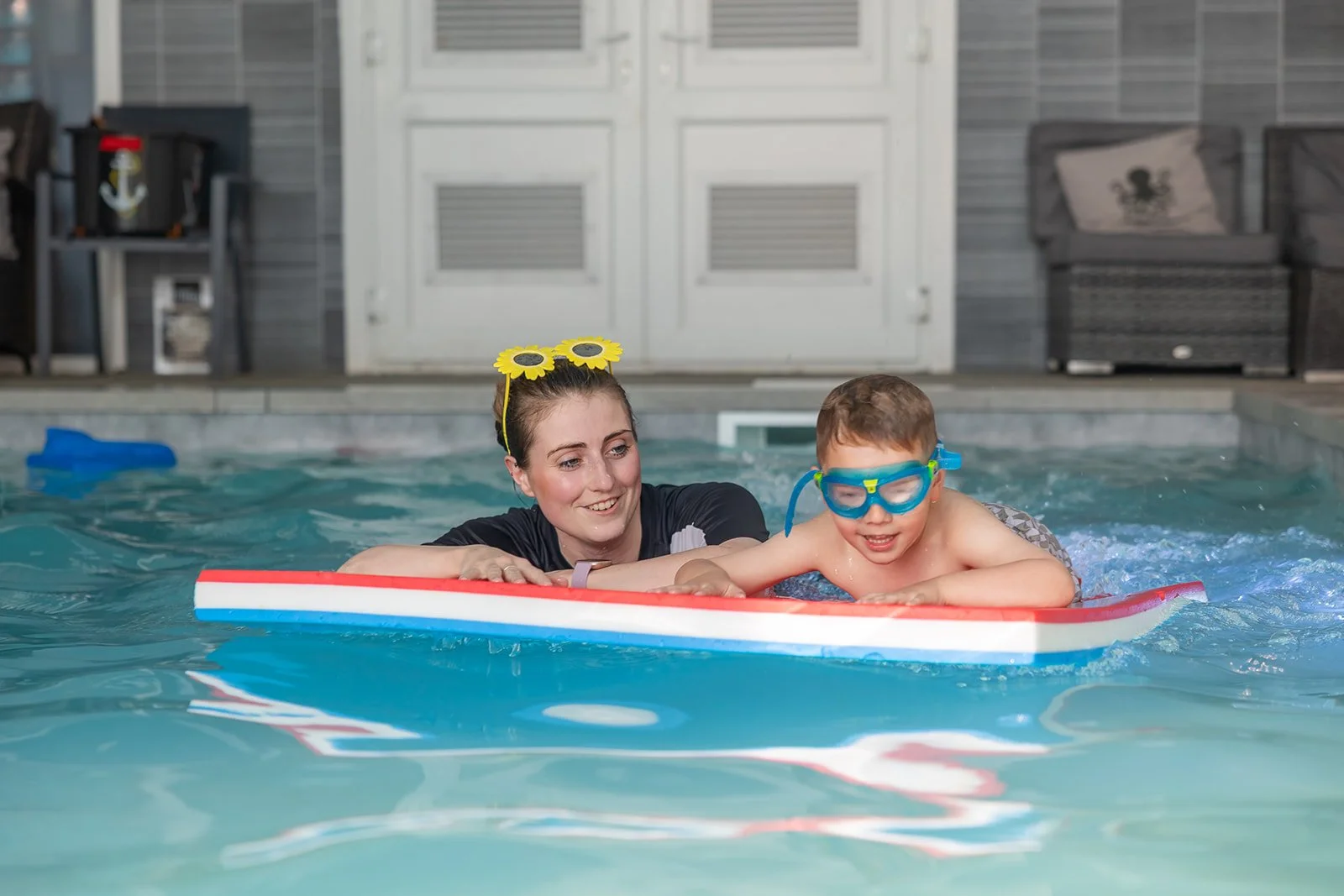
Duckling Awards
Duckling Awards are designed to help toddlers enjoy learning to swim with help from their parents or guardians.
With Duckling Awards your child can work towards four different colourful Awards, and each Award has its own certificate and badge.
Duckling 1 will see children start to move by themselves in the water, and by Duckling 4 they will be jumping in, going underwater, floating and travel 10 metres without support.
-
By completing this Award you should be able to:
Make a supervised safe entry with adult support if required.
Float on back with adult support behind the head without floatation equipment.
Blow bubbles at the water surface.
Wet the head without submersion.
Kick 5 metres on back with adult support.
Travel without adult support for 2 metres to a floating object.
Enter the pool, rotate and return to the side with adult support.
Exit the water safely with minimal adult support.
-
By completing this Award you should be able to:
Make a sitting entry with adult support if required.
Rotate 180 degrees either using a log roll or an upright position, using floatation equipment and without adult support.
Submerge the face with confidence and without force under adult supervision.
Blow an object for a distance of 2 metres.
Travel 3 metres using arms and/or legs without adult support.
Move 5 metres along the rail or wall without adult support.
Enter the pool, rotate and return to the side with minimal adult support.
Exit the water safely with minimal adult support.
-
Duckling 3
By completing this Award you should be able to:
Make a supervised jump to an adult with or without support.
Float on the front or back without adult support.
Push off on the front or back in a streamlined shape from a supporting adult.
Blow bubbles with the mouth and nose underwater.
Travel 5 metres on the front to the side of the pool without adult support.
Kick 5 metres on the front holding a float (the adult may hold the other end of the float).
Enter the pool, rotate and return to the side without adult support.
Climb out of the water with adult support if required.
-
By completing this Award you should be able to:
Jump into the water unaided, but supervised.
Perform a mushroom or star float.
Rotate 360 degrees either using a log roll or an upright position.
Push and glide achieving a streamlined position on the front or back.
Submerge completely.
Travel 10 metres on the front or back, without adult support.
Jump into the water, turn around, swim back to the point of entry and hold on to the side or rail.
Climb out of the water with adult support if required.
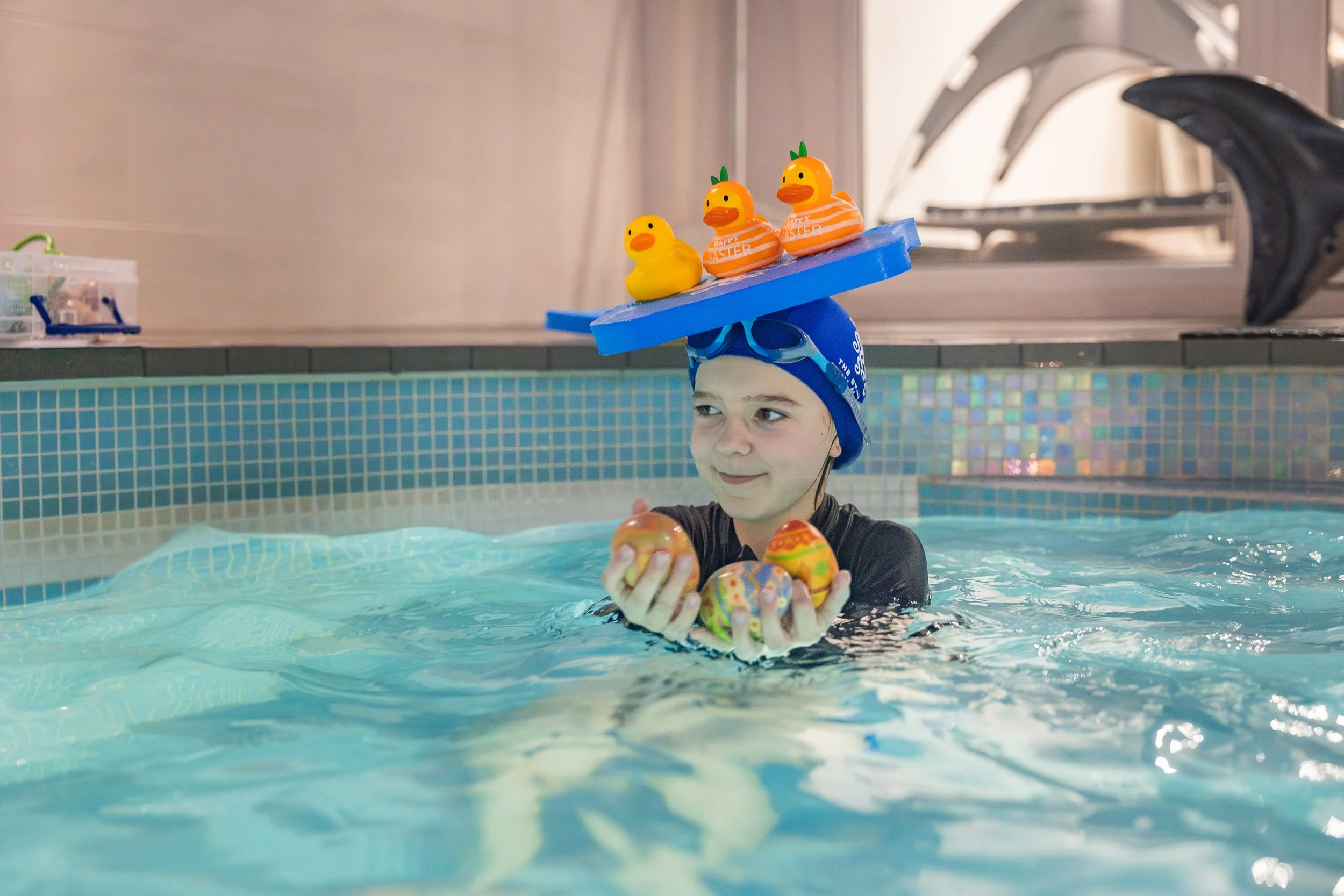
I CAN Awards
Swim England I CAN Awards are perfect for babies, toddlers and pre-school aged children. They recognise achievement of specific single successes for early learners, and can be awarded at any time by your child’s swimming teacher. Your child will enjoy receiving a badge and certificate for nine types of skill development.
The Awards are, I CAN…
• …jump in
• …float on my back
• …blow bubbles
• …enter, turn, return
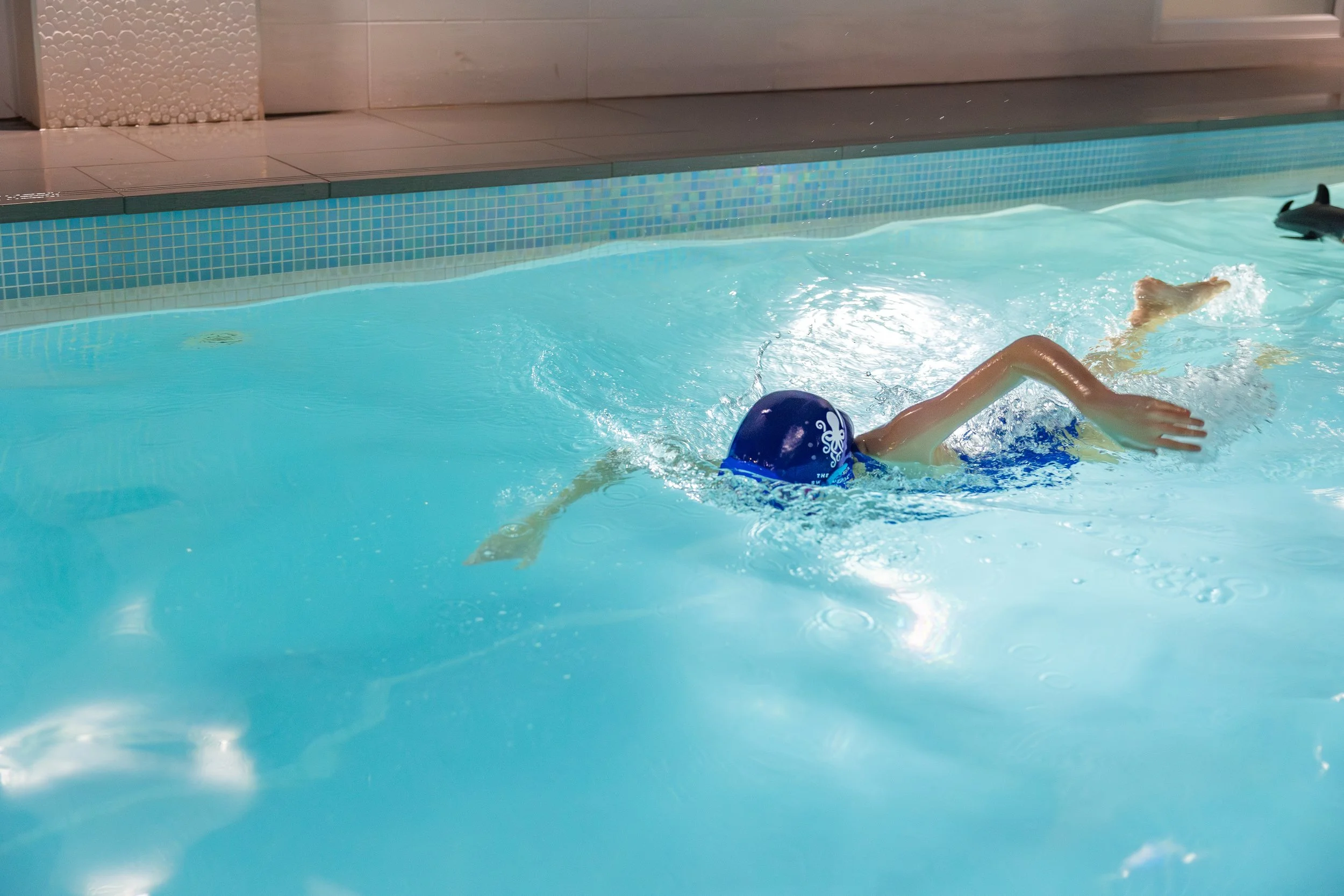
Learn to Swim Stage Awards
At The Standen Swim Academy, our lessons follow the Swim England Learn to Swim framework, the national syllabus for teaching primary school aged children how to swim safely and confidently.
The Learn to Swim Awards are divided into progressive stages from Level 1 to Level 8. Each of the Learn to Swim Stage 1–8 awards includes a clear set of outcomes that children work towards in order to achieve their award.
-
Stage 1
By completing this Award students will be able to:
1. Enter the water confidently and safely using the steps or from the side of the pool (swivel entry), return and exit the pool safely. I CAN ENTER, RETURN & EXIT AWARD
2. Move freely about the shallow end of the pool using hops, skips and jumps.
3. Jump into the water from the side of the pool with confidence, May have assistance. I CAN JUMP IN AWARD
4. Scoop the water and wash their face, remaining calm.
5. Be at ease with water showered from overhead.
6. Put their face in the water, eyes looking down, and blow bubbles for 5 seconds. I CAN BLOW BUBBLES AWARD BACKSTROKE
7. Hold a relaxed star float on back for 5 seconds, arms and legs stretched out, ears in the water. Return to standing position. May have assistance. I CAN FLOAT ON MY BACK AWARD 8. 5m kick on back with hands by sides, flat body position, ears in the water and long legs. No floats but may have assistance. 9. 5m kick on back, independently, no assistance, supported only by a noodle. PUFFIN AWARDFRONT CRAWL 10. Push off the steps or platform on front into a streamlined ROCKET and kick with straight legs, blowing bubbles, face down for 5m. Assistance may be given to support the hands out in front.
11. 5m independent kick on front, no assistance given, supported only by a noodle. PUFFIN AWARD BREASTSTROKE
12. Basic breaststroke kick action (lift, star, snap) in the water lying on front supported by a noodle. Assistance may be given.BUTTERFLY 13. Basic dolphin action in the water on front. Assistance may be given.
-
Stage 2
By completing this Award students will be able to:
1. Starting with toes over the edge, jump into the water safely from poolside, landing feet first (no assistance).
2. Blow bubbles a minimum of three times rhythmically, with nose and mouth submerged, rolling head to the side to inhale. 3. Fully submerge and pick up an object with two hands, eyes open.
4. Starting from a front float, tuck to rotate, to a back floating position, then bring knees up and return to standing. Repeat in reverse order from back to front.BACKSTROKE
5. Push off from the wall or platform and glide on back - arms can be by the side or extended above the head (no assistance).
6. Push from a wall and glide on the back – arms can be by the side or above the head.
7. 5m backstroke kick, with hands by sides, flat body position, ears in the water, long legs, toes at the surface (no floats, no assistance).
8. 5m basic independent backstroke swim, with arms recovering over the surface of the water. Catch up style is acceptable. (no assistance).FRONT CRAWL
9. Push off the steps or platform on front in a streamlined ROCKET and kick with straight legs, blowing bubbles, face down, for 5m (no assistance).
10 Repeat kicking through a hoop underwater.
11. 5m front crawl kick, holding a float or noodle, taking a minimum of 3 breaths by rolling head to the side. 12. 5m front crawl kick, holding a float with 1 hand, the other arm pulling, breathing every1 or 2 arm pulls (as directed by the teacher). 13. 5m basic independent front crawl swim, with arms recovering over the surface of the water. Catch up style is acceptable. At least 1 breath to the side must be taken.BREASTSTROKE
14. 5m breaststroke kick (lift, push, snap) on front. A noodle or floats may be used but no assistance given.BUTTERFLY 15. 5m independent dolphin kick on front, with flowing hip movement and parallel leg kick.Description text goes here
-
Stage 3
By completing this Award students will be able to:
1. Jump in from poolside and fully submerge (no assistance given).
2. Two different styles of float, each of be held for a minimum of 5 seconds
3. Push and glide on the front with arms extended and log roll onto the back.
4. Push and glide on the back with arms extended and log roll onto the front.
5. Rocket 5 metres on the front, perform a tuck to rotate onto the back and return to starting point kicking on the back.
6. Fully submerge to pick up an object.BACKSTROKE 7. Starting from a push and glide on back swim 10m backstroke with a shallow arm pull.
FRONT CRAWL 8. Starting from a streamlined rocket on front, swim 10m front crawl breathing rhythmically to the side.
BREASTSTROKE
9. 10m breaststroke kick (lift, push, snap). Feet turned out, knees remaining shoulder width apart and incorporating a glide. Feet must be flat (dorsiflexed) during push back. A board or noodle may be used for support.BUTTERFLY 10. 10m dolphin kick on front, arms extended
WATER SAFETY 11. Correctly identify three of the four key water safety messages.*
*The four key water safety messages include:
1. Always swim in a safe place.
2. Always swim with an adult.
3. If you fall in, float, breathe, relax.
4. If someone else in trouble, call 999/112. -
Stage 4
By completing this Award students will be able to:
1. Perform a sequence of changing shapes (minimum of three) whilst floating on the surface and demonstrate an understanding of floating. 2. Push and glide from the wall, platform or steps and rocket down at an angle and through an under water hoop sitting on the pool floor. 3. Streamlined rocket into a forward somersault. 4. Streamlined rocket into a 360 degree log roll. 5. Head first sculling action for 5m in a flat position on the back.BACKSTROKE 6. From a push and glide on back, swim 10 metres back stroke, with straight arm recovery, little finger entry, thumb exiting. UW pull may be a shallow straight arm pull or a bent arm pull, but NOT a deep windmill action. Both the leg kick and the arm pull should be continuous.
FRONT CRAWL 7. Starting from a push and glide on the front, swim 10m front crawl breathing to the side. Swimmers should have mastered aquatic breathing, exhaling under water and be able to turn their heads to both the left and right side to inhale. Arms should be alternating, front quadrant style and be recovering over the surface of the water.
BREASTSTROKE 8. 10m breaststroke kick incorporating correct timing of breathing. The kick must be heels lifting to hips, no knees under tummy, thighs remaining still, feet turned out. At at the end of each kick there should be a glide with legs held straight and together. No screw kicks. No equipment to be used. 9. Correct timing of breaststroke breathing in combination with a straight arm out scull and in scull. Floats may be used as support under hands. Arms must be held straight. Can be practised with either front crawl or breaststroke kick.
BUTTERFLY 10. Demonstrate basic butterfly arm pull (without any leg kick) in slow motion, standing waist deep in water and/or floating face down. A pull buoy may be used to support the legs at the surface.
-
Stage 5
By completing this Award students will be able to:
1. Demonstrate streamlined fc/br/bk starts off the wall. Starting at the wall with 1 arm extended, one hand on the wall, the hand leaves the wall with arm recovering over the top, hands lock together squeezing the ears as swimmer drops down uw, eyes looking down. Swimmer pushes off, arms must be in a tight streamlined position, squeezing ears, before toes leave the wall. 2. Demonstrate a streamlined backstroke start off the wall, with arms extended, either from a drop down uw or by arms being thrown over the top. 3. Push and glide off the wall into a handstand. 4. Tread water for 30 seconds, stress free. 5. Perform a sculling sequence with a partner for 30-45 seconds to include a rotation.
6. Perform a straddle entry, keeping head above water on entry.
7. Perform 3 different types of jump, with a vertical, foot first entry into the water.
8. Demonstrate action for requesting help (tread water, 1 hand above head and shout for help).BACKSTROKE
9. Push and glide and swim 10 metres backstroke (performed to Swim England expected standards). Body almost horizontal, hips slightly submerged, controlled roll of shoulders. Continuous leg kick from hips, legs close to the surface, small splash of the feet. Hand entry in line with the shoulder, little finger entering first. Straight arm recovery. The uw pull may be straight arm or bent arm. Pull and kick co-ordinated, steady head position.FRONTCRAWL 10. Push and glide and swim 10 metres front crawl (performed to Swim England expected standards). Front quadrant style. Regular breathing with ease to both sides. No sneaky looks forward. Steady, long leg kick, toes making a splash at the surface. Arm recovery may be straight over the top, or bet arm with a high elbow. Hand enters softly finger tips first stretching forward in a line between head and shoulder.
BREASTSTROKE
11. Push and glide and swim 10 metres breaststroke (performed to Swim England expected standards). There must be a streamlined glide between strokes. The kick should be simultaneous, heels lifting to hips, not knees tucking under tummy, knees remaining stable. Feet turned out during the kick, feet together with toes pointed for the glide. The pull should be with a simultaneous sculling action, hands not pulling past shoulders and without taking a pause under the chest. Head and body lifts as arms out scull, breath is taken during the propulsive in scull, face returns to the water during the recovery of the arms.BUTTERFLY 12. Push and glide and swim 10 metres butterfly (performed to Swim England expected standards). The whip like kick should be simultaneous with the hips lifting and lowering causing full action of the legs and feet. The arm action should be simultaneous with arms recovering over the surface of the water.
-
By completing the Learn to Swim Stage 6 Award, swimmers will be able to:
Give two examples of how to prepare for exercise and understand why it is important.
Sink, push off on side from the wall, glide, kick and rotate into backstroke.
Sink, push off on side from the wall, glide, kick and rotate into front crawl.
Swim 10 metres wearing clothes.
Push and glide and swim front crawl to include at least six rhythmical breaths.
Push and glide and swim breaststroke to include at least six rhythmical breaths.
Push and glide and swim butterfly to include at least three rhythmical breaths.
Push and glide and swim backstroke to include at least six regular breaths.
Push and glide and swim 25 metres, choice of stroke is optional (performed to Swim England expected standards).
Perform a ‘shout and signal’ rescue.
Perform a surface dive.
-
By completing the Learn to Swim Stage 7 Award, swimmers will be able to:
Push and glide and swim 25 metres backstroke (performed to Swim England expected standards).
Push and glide and swim 25 metres front crawl (performed to Swim England expected standards).
Push and glide and swim 25 metres breaststroke (performed to Swim England expected standards).
Push and glide and swim 25 metres butterfly (performed to Swim England expected standards).
Perform a movement sequence (linking skills with strokes and sculls) of one minute duration, in a group of three or more, incorporating a number of the following skills:
Sculling: head first, feet first
Rotation: forward or backward somersault, log roll
Floating: star on the front or on the back, tuck float, create own
Eggbeater: Moving, lifting one or both arms out of the waterPerform a sitting dive or dive.
Push and glide and swim 50 metres continuously using one stroke (performed to Swim England expected standards).
Push and glide and swim 100 metres, using a minimum of three different strokes (performed to Swim England expected standards).
Tread water using eggbeater action for 30 seconds.
Complete an obstacle course (using minimum of four objects) with feet off the pool floor throughout.
-
y completing this Award you will be able to:
Complete a set lasting 400 metres (e.g. 16 x 25 metres, 8 x 50 metres, 4 x 100 metres) on a specific turnaround time agreed by the teacher or coach (e.g. 1.00 minutes for each 25 metres) with a focus on stroke technique and consistency.
Swim 400 metres continuously using one stroke.
Push and streamline then kick 25 metres backstroke with or without using a board.
Push and streamline then kick 25 metres breaststroke with or without using a board.
Push and streamline then kick 25 metres butterfly without using a board.
Push and streamline then kick 25 metres front crawl with or without using a board.
Perform a backstroke turn from 10 metres in to 15 metres out.
Perform a breaststroke turn from 10 metres in to 15 metres out.
Perform a butterfly turn from 10 metres in to 15 metres out.
Perform a front crawl turn from 10 metres in to 15 metres out.
Perform a dive track or grab start, and kick butterfly underwater in a streamlined position for 5 metres with the focus on progressing it to 10 metres.*
*Delivery will depend on the pool design and facilities available.
-
By completing this Award, learners should be able to perform:
Tread water vertically and comfortably for 30 seconds, using eggbeater kick.
Maintain a vertical position whilst moving forwards, backwards, left and right, using sculling and eggbeater kick for 5 metres.
Maintain a horizontal position whilst moving forwards, backwards, left and right, using sculling and eggbeater kick for 5 metres.
Perform 5 metre horizontal lateral slides, to the right, return to centre and then left and return to centre.
Swim 5 metres head up front crawl.
Swim forwards 5 metres whilst controlling a ball in front.
In vertical eggbeater, pick up the ball from underneath the surface with alternate hands into a throwing position.
Hold a tripod position, with a ball, for 30 seconds.
Play a simple water polo game, score by placing ball on the side of the pool and demonstrate skills learnt during this stage.
-
By completing this Award, learners should be able to perform:
Front push and glide with hands grabbed.
Back push and glide with hands grabbed.
Tuck float to stretched position.
Forward somersault in the water.
Push and glide into a forward tucked somersault to finish upright.
Sitting forward dive with hands grabbed from poolside.
Sitting pike line up on dry land.
-
By completing this Award you will be able to:
Complete a set lasting 800 metres (either 16 x 50 metres, 8 x 100 metres, 4 x 200 metres) on a specific turnaround time agreed by the teacher or coach (e.g. 1.30 minutes for 50 metres) with a focus on stroke technique and consistency.
Swim 800 metres continuously using one stroke.
Swim a continuous 100 metre individual medley (4 x 25 metres) using recognised turns with a focus on stroke technique and consistency.
Perform a 15 metre underwater kick on front from a push and glide in a streamlined position.
Perform a backstroke start then butterfly kick in a streamlined position underwater up to a maximum of 15 metres from the start point (wall). Transfer into stroke and complete the remainder of the 25 metres.*
Perform a front crawl start then kick in a streamlined position underwater up to a maximum of 15 metres from the start point (wall). Transfer into stroke and complete the remainder of the 25 metres.*
Perform a butterfly start then kick in a streamlined position up to a maximum of 15 metres from the start point (wall). Transfer into stroke and complete the remainder of the 25 metres.*
Perform a breaststroke start then perform a one and a half pull underwater. Transfer into stroke and complete the remainder of the 25 metres.*
*Delivery will depend on the pool design and facilities available.
-
By completing this Award, learners should be able to perform:
Swim 5 metres head up front crawl, change direction 90 degrees left, swim 5 metres change direction 90 degrees right.
Swim 5 metres head up front crawl, change direction through 180 degrees, swim 5 metres.
Swim 5 metres water polo backstroke.
Swim 5 metres water polo head up front crawl, turn onto back, continue in same direction for 5 metres and turn back onto front and swim 5 metres.
Swim 5 metres head up front crawl with breaststroke legs.
Pass and catch a ball accurately with a partner, with one hand, over a 3 metre distance while maintaining a strong body position.
Swim 10 metres head up front crawl, receive a ball on the water, and continue to swim whilst controlling the ball.
Swim 5 metres with a ball, pass ball to target, and continue to swim 5 metres.
Pick up a ball, shoot at a target from a 2 metre distance and repeat five times. The target may be a player, kick board, plastic bottles, etc.
Play a simplified water polo game, score by hitting a target on the side of the pool or some other adaptation and demonstrate skills learnt during this stage and in Learn to Swim Stage 8 Water Polo.
-
By completing this Award, learners should be able to perform:
Forward jump straight from poolside.
Back jump straight from poolside.
Pike float to stretched position.
Forward jump tuck from poolside.
Forward tuck roll from poolside.
Forward pike fall from poolside.
Push and glide with a half twist – front and back.
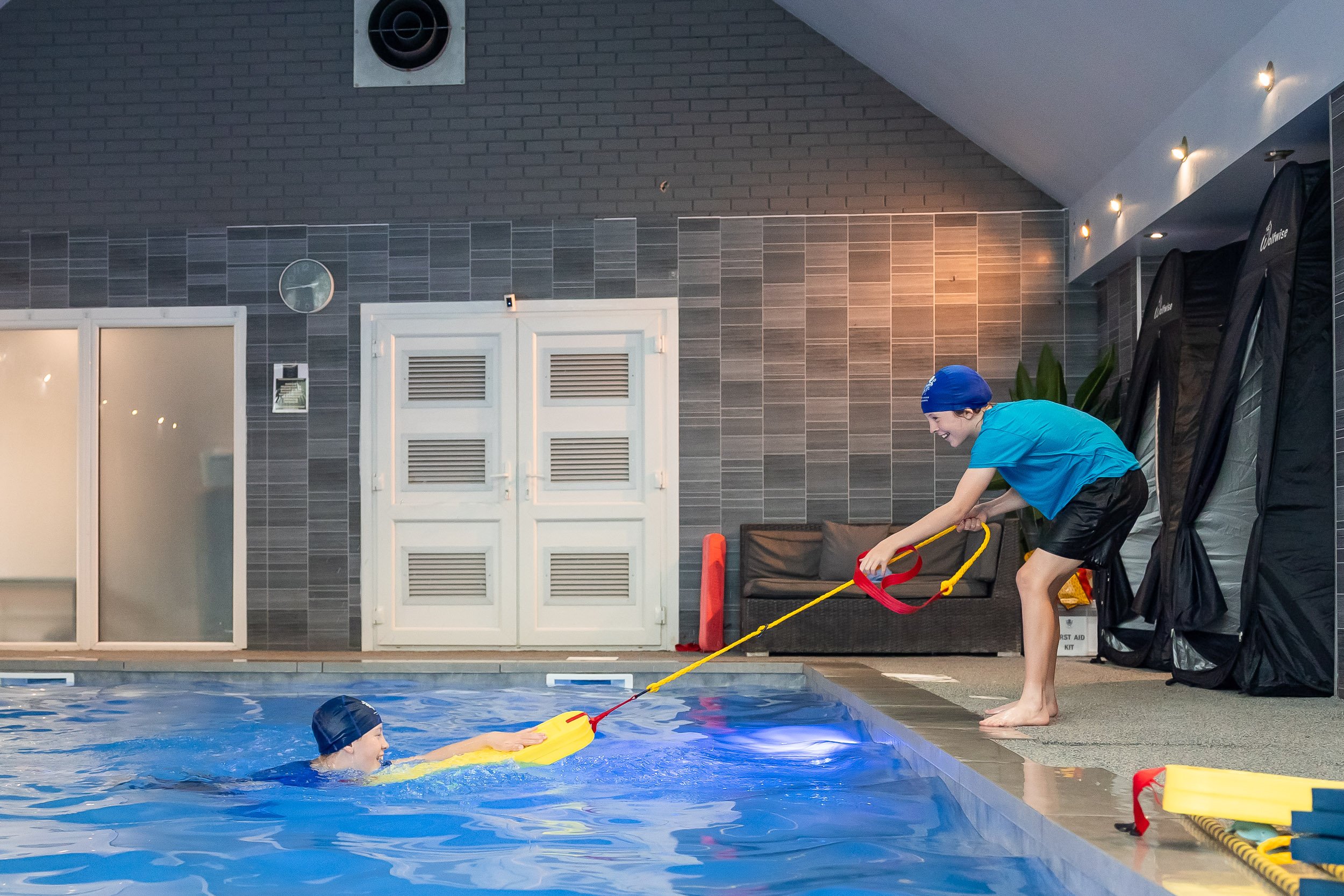
Water Safety Awards
There are three Water Safety Awards teaching water danger awareness, self-rescue techniques and vital survival skills in clothes, without swimming goggles.
The Water Safety Awards have been developed in partnership with Royal National Lifeboat Institution (RNLI) and Royal Lifesaving Society UK (RLSS UK). They are a lifesaving skill for any child.
Each of the Water Safety Awards has a number of skills (outcomes) that must be completed before your child is awarded their certificate, cloth badge and optional pin badge by their swimming teacher.
-
Water Safety 1 Award
The outcomes of this Award should be performed in shoulder-depth water, without goggles and in regular swimwear.
1. Perform a swivel entry.
2. Jump in and immediately rotate 180 degrees to travel back to the side.
3. Float on the back for 30 seconds.
4. Fully submerge, exhale and resurface.
5. Log roll from floating on the front to floating on the back.
6. Tread water in an upright position for 10 seconds without floatation equipment.
7. Perform a signal for help on the back, whilst holding onto floatation equipment.
8. Exit the water safely without support.
9. Show an understanding of water safety.. -
Water Safety 2 Award
The outcomes of this Award should be performed in water of at least full reach depth, without goggles and light clothing (shorts and t-shirt). 1. Perform a fall in entry.
2. Float on the back for 60 seconds without floatation equipment and explain why this is important.
3. Tread water for 30 seconds without floatation equipment.
4. Perform a rotation of 360 degrees whilst treading water without floatation equipment.
5. Signal for help whilst treading water without floatation equipment.
6. Swim on the front for 10 metres, log roll onto the back and then rest for 60 seconds; return to an upright position to tread water.
7. Swim 10 metres on the front, log roll and swim 10 metres on the back to a floating object.
8. Swim for 10 metres towards the side of the pool using long arm front paddle (survival stroke).
9. Fully submerge to the pool floor; rhythmically bounce from the pool floor to the surface to take a breath; re-submerge. Repeat four times. 10. Demonstrate the Heat Escape Lessening Position (HELP) with a floating object.
11. Climb out from the side, without using the steps.
12. Recite and show understanding of the four key water safety messages. -
Water Safety 3 Award On completing this third and final Water Safety Award your child will fully understand how to perform safe self-rescue in different open and pool-based water situations, and what to do if they fall into water unexpectedly.
Rainbow Distance Awards
The Swim England Rainbow Distance Awards are designed to complement the different stages of the Swim England Learn To Swim Programme. The Rainbow Distance Awards (including Puffin Award) are aimed at swimmers five years plus and are designed to demonstrate the pupils’ ability to swim from A to B without pause and without stress.
They are a great way to give swimmers the incentive to develop their swimming abilities and stamina by gradually increasing the distance they can swim. Pupils may touch the side and end of the pool (but not the bottom) in order to turn.
At The Standen Swim Academy, we award different distance badges to reward a specific distance covered by the swimmers:
Puffin, 5m, 10m, 20m, 25m, 50m, 100m, 200m, 400m, 800m, 1km
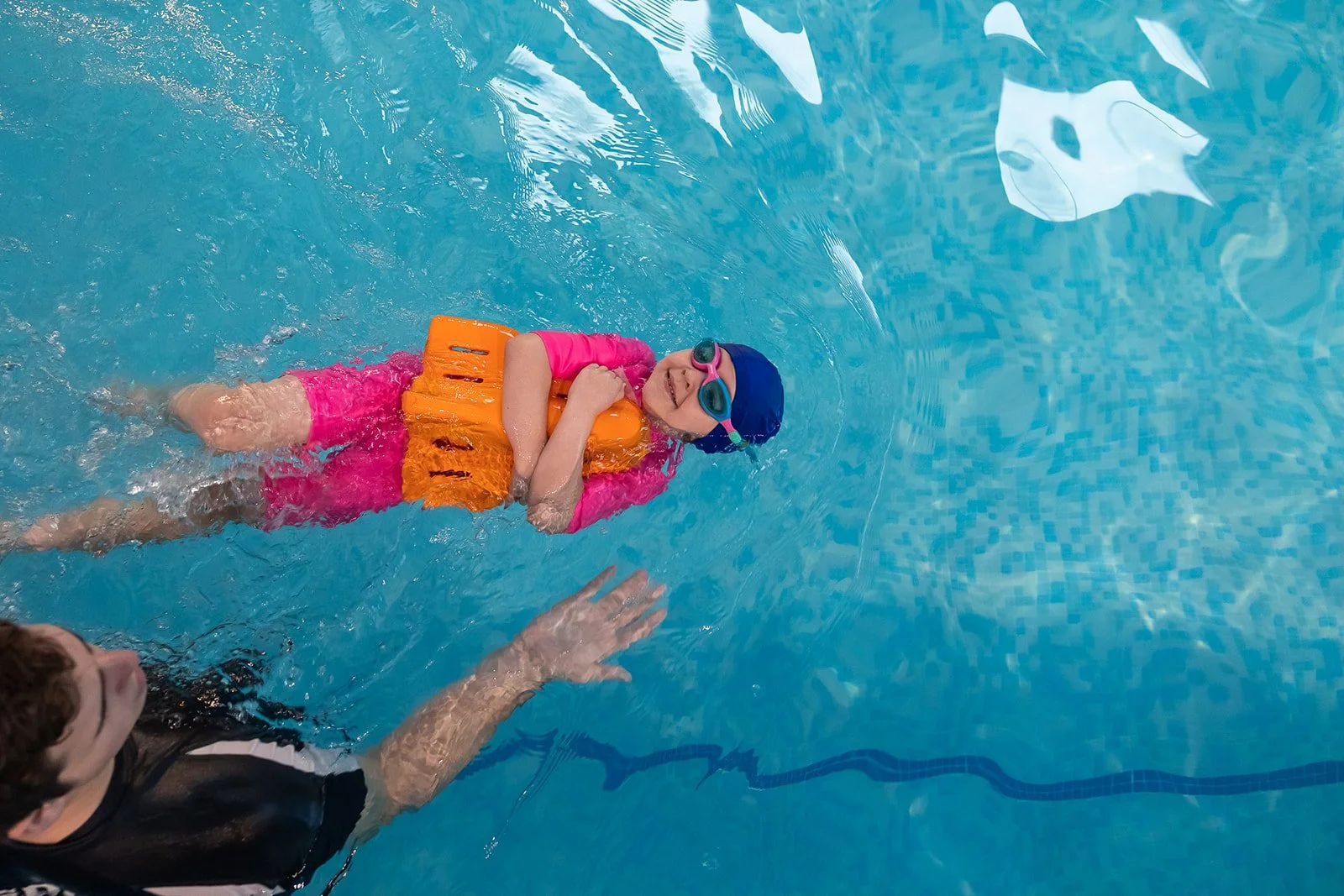
Puffin Award : This award is aimed at beginners and is designed to test the pupils’ ability to travel five metres using any floatation equipment.
Swimming Challenge Awards
The Swim England Swimming Challenge Awards are available for all to complete.
Learners will be challenged to develop a wide range of skills and stamina to achieve the Awards, focusing on good stroke style.
Stroke style for the Swim England Swimming Challenge Awards doesn’t have to comply with Swim England law, but strokes must be co-ordinated, smooth and efficient.
Together with four certificates and accompanying badges, the Awards also come with a metal lapel badge with butterfly fastener as an optional extra.
-
For the following grades Sections A and B may be completed on two different occasions, but each section must be completed without pause and in the order listed. This group of skills test the learner’s ability:
Section A
Jump into water of at least full reach depth.*
Swim 10 metres, followed by a surface dive into water of at least full reach depth* and underwater swim for a distance of 5 metres.
Tread water in a vertical position for three minutes.
Scull head-first on the back for 15 metres with the feet at, or near, the surface throughout.
Section B
Swim 400 metres using two strokes. (Changes of stroke can only occur at the completion of a length of the pool. A minimum of 100 metres is to be swum with each stroke.)
Climb out at the deep end without assistance.
* Full reach depth is the distance from feet to finger tips of hands reaching above the head.
-
By completing this Award, you will have shown your ability to complete each of the following sections in the order listed without pause:
Section A
Plunge dive into water of at least full reach depth.*
Swim 100 metres in less than three minutes using any stroke. A change of stroke may only occur at the completion of a length of the pool.
Tread water for two minutes with one hand behind the back.
Swim 10 metres, followed immediately by two surface dives into water of full reach depth*, one head first and one feet first, bringing an object to the surface on each occasion.
Scull head first on the back for 10 metres and return by sculling 10 metres feet first. A horizontal position must be maintained throughout.
Section B
Swim 800 metres: 400 metres on the front and 400 metres on the back. A change of stroke may only occur every 50 metres.
Climb out at the deep end without assistance.
* Full reach depth is the distance from feet to finger tips of hands reaching above the head.
-
By completing this Award, you will have shown your ability to complete each of the following sections in the order listed without pause:
Section A
Plunge dive into water of at least full reach depth* and swim 100 metres in two minutes 30 seconds or less, using two different strokes, 50 metres of each.
Tread water for three minutes with one hand remaining above the head throughout. The arm raised may be changed no more than five times.
Scull head first on the back for 10 metres, move into a tucked position and turn through 360 degrees keeping the head above water. Return to the starting point by sculling feet first with the feet at or near the surface throughout and the hands close to the hips.
Swim 10 metres, perform a forward somersault without touching the pool bottom and continue to swim in the same direction for a further 10 metres.
Section B
Swim 800 metres using three of the following strokes: front crawl, backstroke, breaststroke, butterfly, English backstroke or sidestroke for a minimum distance of 200 metres per stroke. A change of stroke may only occur every 100 metres. This swim to be completed in 25 minutes.
Climb out at the deep end without assistance.
* Full reach depth is the distance from feet to finger tips of hands reaching above the head.
-
By completing this Award, you will have shown your ability to complete each of the following sections in the order listed without pause:
Section A
Make a straddle entry into water of at least full reach depth*, swim 5 metres into a piked surface dive to retrieve an object weighing approximately 2kg from water of full reach depth*; carry the object using a backstroke or sidestroke for a distance of 20 metres, to place it on the poolside.
Scull 10 metres head first on the back; complete a back somersault finishing in a back layout position; perform a roll to take up a front layout position; carry out a front somersault finishing in a front layout position; tuck and rotate backwards into a back layout position and continue to scull feet first for 15 metres. Throughout all sculling and layout positions, the hands must remain close to the hips and the feet must be kept together on or near the surface of the water.
Section B
Complete the following in a total time of 20 minutes without a pause:
Swim 200 metres front crawl, 200 metres backstroke and either 100 metres breaststroke or 50 metres butterfly. A change of stroke may only occur every 100 metres (except for butterfly).
Swim 500 metres freestyle during which surface dive twice head first and twice feet first; on each surface dive, swim through two hoops 4 metres apart without surfacing. The tops of the hoops are to be at least 1 metre below the surface of the water.
* Full reach depth is the distance from feet to finger tips of hands reaching above the head.
Alpha Step Awards
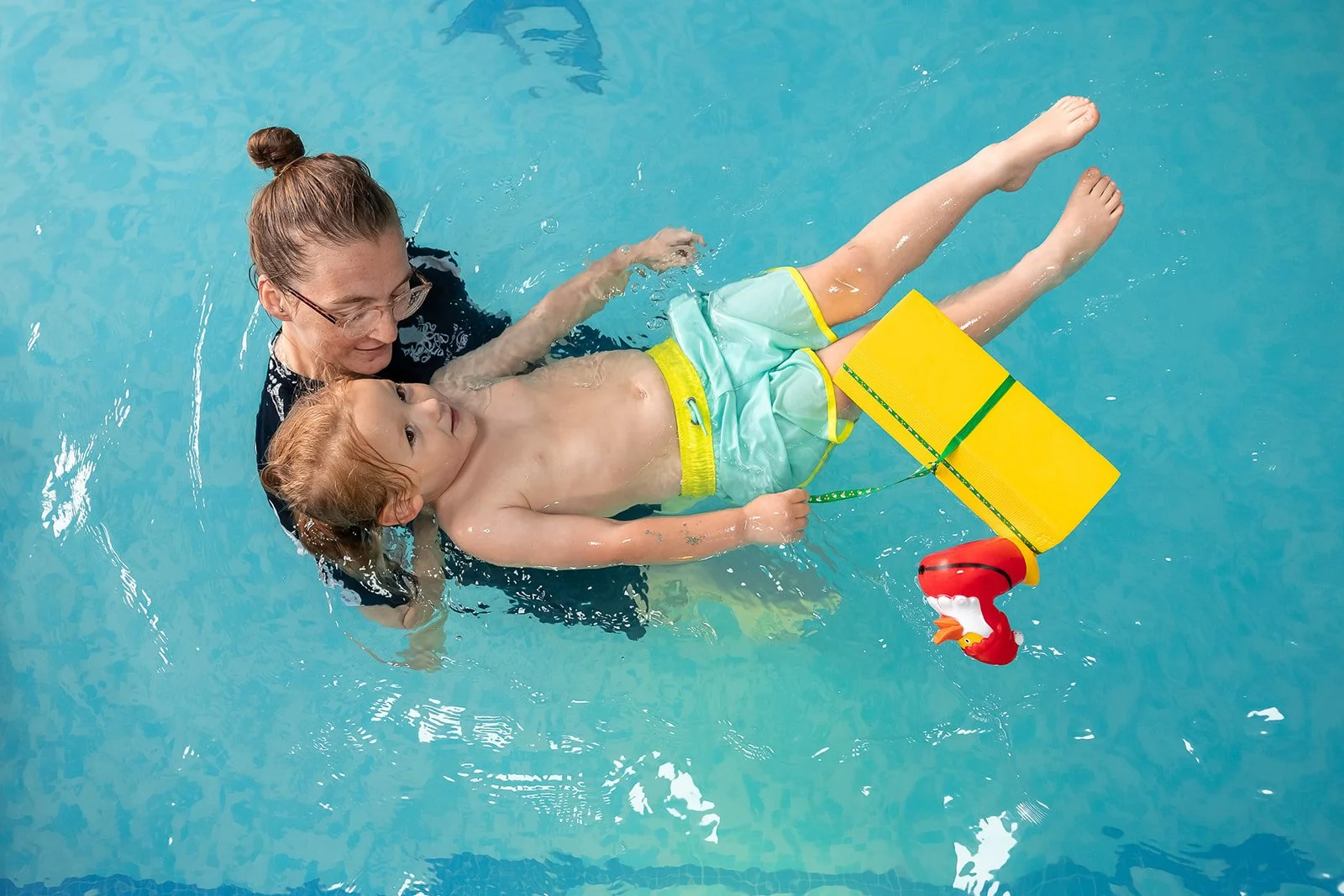
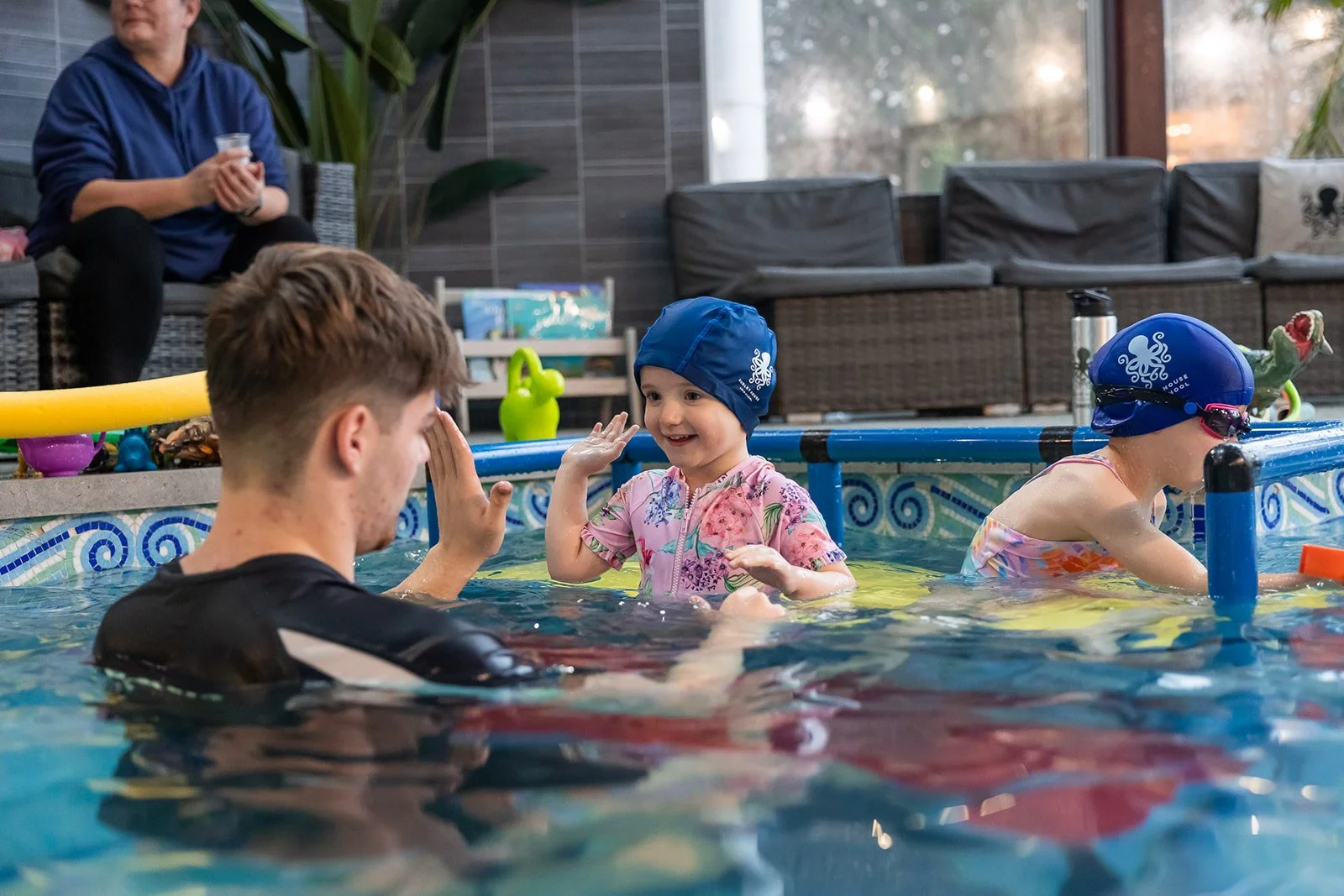
The Alpha Step Awards are designed to build confidence in those who may need additional support during their swimming lessons.
They are particularly relevant for a shy/timid child, a nervous adult and some individuals with special educational needs and/or disabilities (SEND).
The Alpha Step Awards reward the development of the early stages of buoyancy, coordination, spatial awareness, breathing, and entering and leaving the pool safely.
The basic water skills and confidence gained through these Awards enable a smooth transition to Learn to Swim Stage 1 Award of the Swim England Learn to Swim Framework.
Achievements of the Alpha Step Awards
There are three Alpha Step Awards in total, covering the following skills:
Entries
Enter the water safely with equipment or support.
Enter the water safely with minimal support.
Enter the water safely with no assistance or support.
Aquatic Breathing
Blow to move a floating object over 3 metres.
Tolerate face being (splashed) wet.
With mouth submerged, blow bubbles.
Spatial Awareness
On the spot move selected object around.
Whilst travelling, move objects in or through the water.
Move objects to or from a partner in various directions.
Rotation
Be rocked through the water with support.
Turn 360 degrees with minimal assistance.
Lie back and move to a vertical position with support.
Buoyancy
Float with support.
Float on front with support.
Float on back with support.
Co-ordination
Be towed (forwards, backwards and sideways) in a variety of directions.
Travel through the water using limbs with minimal support.
Travel 3 metres on front with or without floatation equipment.
Travel 3 metres on back with or without floatation equipment.
Exits
Exit the water safely with equipment or support.
Exit the water safely with minimal support.
Exit the water safely with no assistance or support.
How to achieve Alpha Step Awards
The number of skills needed to achieve each Award are as follows:
Alpha Step 1
Six out of 22 skills (maximum of one skill from each section).
Alpha Step 2
12 out of 22 skills (maximum of two skills are to be gained from each section).
Alpha Step 3
17 out of 22 skills (one skill must be gained from all sections).